
 sale@henanminecranes.com
  +86 16627702870

In the world of material handling and heavy lifting, few machines are as recognizable or as versatile as the gantry crane. While overhead bridge cranes are fixed to the building structure, a gantry crane operates on the ground, supported by legs that run on wheels or rails. This fundamental difference makes it an indispensable tool in shipyards, construction sites, warehouses, and rail yards.
But what exactly is a gantry crane, and why would you choose one over a traditional overhead crane? This article provides a comprehensive breakdown of the gantry crane, including how it works, the different types available, and the key advantages that make it a global leader in industrial lifting.
Gantry Crane Definition?
A gantry crane is a type of overhead crane that lifts heavy objects using a hoist mounted on a horizontal beam (bridge). Unlike a bridge crane which requires runway beams attached to the building, a gantry crane is self-supporting. It consists of:
Two or more leg supports (one on each side)
A horizontal bridge/girder spanning the legs
A hoist and trolley that move laterally across the bridge
Wheeled end trucks allowing the entire crane to travel along the floor or on rails
Because the legs create a "portal" shape, gantry cranes are often called portal cranes, especially in heavy-duty applications.
How Does a Gantry Crane Work?
The operational principle of a gantry crane is deceptively simple but highly effective.
Lifting: The hoist (either electric, pneumatic, or manual) raises the load vertically.
Cross Travel: The trolley moves the load horizontally across the bridge girder, from one leg side to the other.
Long Travel: The entire crane structure rolls on wheels along the floor, rails, or a concrete pad, allowing the load to be moved long distances across a yard or workshop.
This three-dimensional movement (up/down, left/right, forward/back) gives operators complete control over load placement without needing to reposition the truck or ship underneath.
Types of Gantry Cranes
1. Semi-Gantry Crane
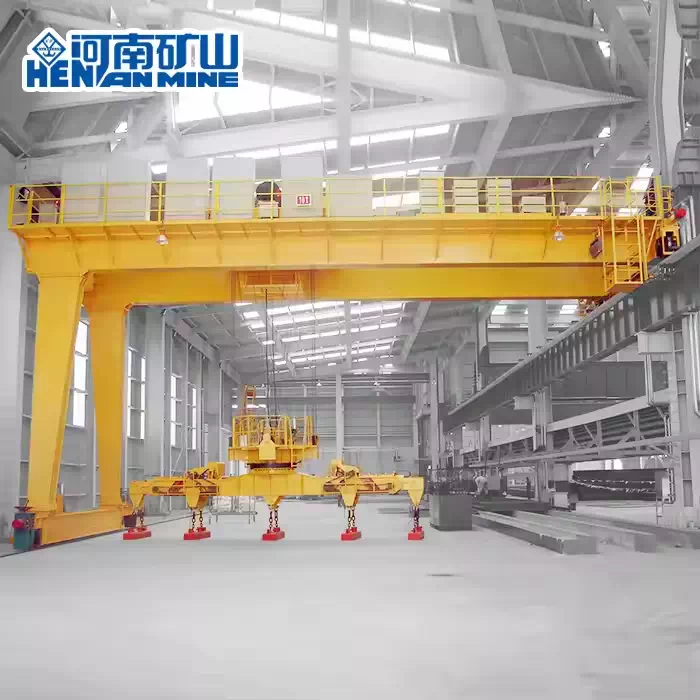
One side of the crane runs on a floor-level rail, while the other side runs on an elevated runway (attached to a building wall). These are perfect for facilities where floor space is limited on one side.
2. Rubber-Tired Gantry (RTG) Crane
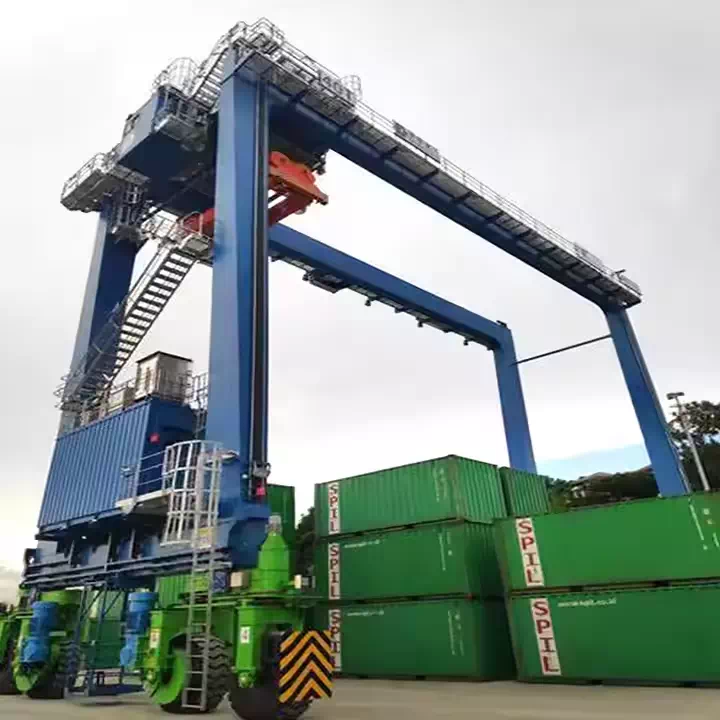
The king of container yards. RTG cranes run on rubber tires instead of rails, allowing them to move anywhere in a container terminal. They are massive (often lifting 40-50 tons) and are used to stack 4-5 containers high.
3. Rail-Mounted Gantry (RMG) Crane
Similar to an RTG but runs on fixed rails. RMGs are faster and more precise than rubber-tired models. They are typically used at rail terminals and intermodal facilities where loads follow a dedicated straight path.

Key Components of a Gantry Crane
Understanding the parts helps you know what to inspect and maintain:
Girder / Bridge: The main horizontal beam.
End Trucks: House the wheels and drive motors for long travel.
Legs: The vertical supports connecting the end trucks to the girder.
Hoist: The lifting mechanism (chain or wire rope).
Trolley: Moves the hoist along the beam.
Control System: Pendant station, radio remote, or cabin controls.
Outriggers: Stabilizers on large cranes to prevent tipping.
Gantry Crane vs. Overhead Bridge Crane: What’s the Difference?
| Feature | Gantry Crane | Overhead Bridge Crane |
|---|---|---|
| Support | Freestanding legs on floor | Building runway beams |
| Installation | Low cost, temporary or permanent | High cost, permanent building modification |
| Floor Space | Takes up floor space (legs) | Uses zero floor space |
| Mobility | Typically mobile (wheels/rails) | Fixed to one bay |
| Ideal For | Outdoor yards, rental yards, low-ceiling shops | High-bay indoor manufacturing |
Advantages of Using a Gantry Crane
No Building Modifications: Because the crane supports itself, you don’t need reinforced columns or runway rails installed in your ceiling. This is a massive saving for rental properties or outdoor sites.
Portability: Smaller gantry cranes can be disassembled and moved to different job sites. Some fold up for storage.
Versatility: One crane can serve multiple work stations. Roll it from the welding bay to the loading dock.
Outdoor Capability: Bridge cranes are indoor tools. Gantry cranes are built for the weather (shipyards, scrap yards, lumber yards).
Cost-Effective for Low Capacity: For loads under 10 tons, a portable gantry crane is dramatically cheaper than a building-supported system.
Common Applications
You will find gantry cranes operating in the following environments:
Shipping & Ports: Loading/unloading containers (Ship-to-Shore cranes are a specialized type of gantry).
Rail Yards: Lifting train engines or moving intermodal containers.
Construction Sites: Moving rebar, precast concrete, and HVAC units.
Warehouses & Distribution: Loading flatbed trucks where a forklift cannot reach.
Aerospace: Lifting jet engines or fuselage sections during assembly.
Auto Repair: Engine hoists (essentially mini portable gantry cranes).
How to Choose the Right Gantry Crane
If you are considering buying a gantry crane, ask these five questions:
What is the maximum load? (Add 25% safety margin)
What is the required span? (Distance between legs)
What is the lifting height? (Under-beam clearance)
Will it be used indoors or outdoors? (Weather protection vs. no)
Move or stationary? (Fixed rail vs. rubber tires vs. manual push)
Safety Considerations
Gantry cranes are powerful, but they pose significant risks if misused. Always follow OSHA guidelines:
Never exceed the rated capacity (the load chart is legally mandatory).
Check for floor bearing capacity – concrete floors must withstand the wheel load.
Use outriggers on tall or heavy-lift gantries.
Inspect wheels and rails for debris or wear weekly.
Train operators on remote control use and load swing control.
Conclusion
A gantry crane is much more than just a hoist on wheels. It is a flexible, cost-effective, and powerful solution for moving heavy goods in environments where a permanent overhead crane is impractical or impossible. From the small adjustable gantry in an auto garage to the massive rubber-tired giants stacking containers at a busy seaport, these machines are the backbone of modern heavy logistics.If you need to lift, move, and place heavy loads without changing your building structure, a gantry crane is likely the answer.
Henan Mining Cranes Co., Ltd. is a leading crane manufacturer in China. With decades of industry experience, we have become a trusted partner in the global material handling solution field. We are committed to providing comprehensive professional services tailored to your specific needs. We recommend the most suitable crane products, offer accurate quotations, and design customized solutions. Welcome to contact us.
Get In Touch
Email: sale@henanminecranes.com
Website: https://henanminecrane.com/
Whatsapp:16627702870